
How Many Bricks for a Square Feet of Paving? Homeowners Essential Guide
Table of Contents
Share this Article
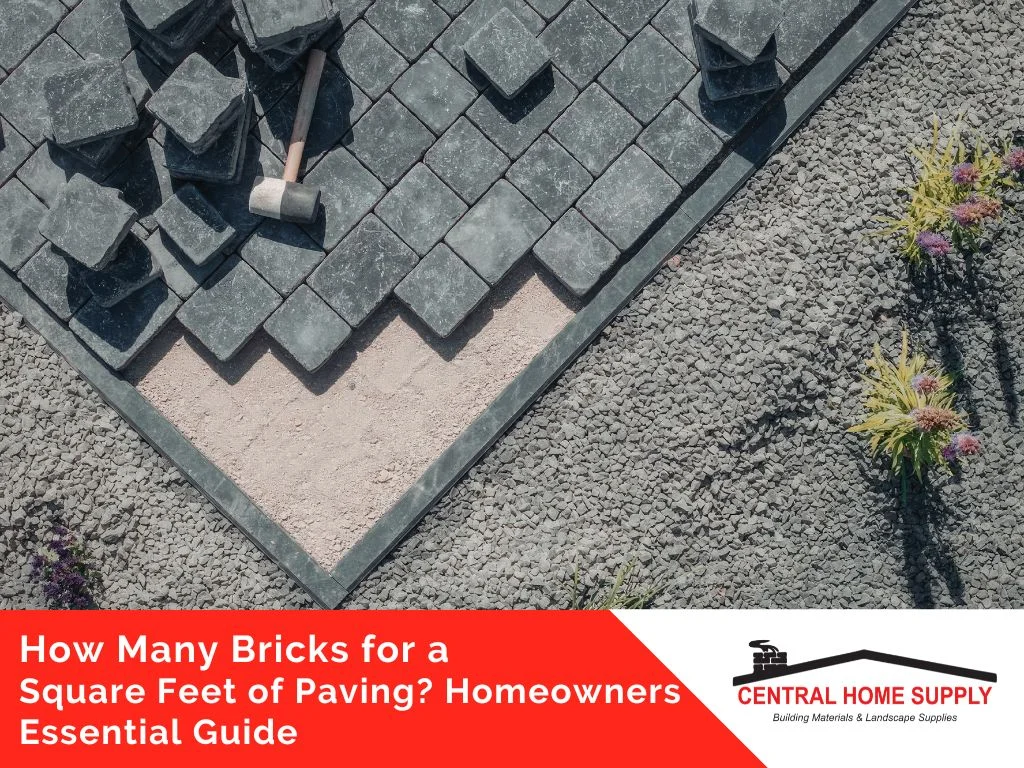
Why Getting Block Paving Bricks per Square Foot Right Matters Before You Buy
Block paving bricks per square foot is one of the most important numbers to get right before ordering materials for any driveway or patio project.
Order too few and your project stalls. Order too many and you’ve wasted money. Getting the number right from the start saves you both.
Here’s the quick answer:
| Block Size (mm) | Blocks per square foot |
|---|---|
| 200 x 100 (standard) | 4.65 |
| 150 x 100 | 6.22 |
| 100 x 100 | 9.29 |
| 225 x 112 | 3.72 |
Always add at least 10% extra on top of your calculated total to cover cuts, breakages, and pattern waste.
So for a standard 200 x 100mm block on a 215-square-foot driveway, you’d need:
- 215 x 4.65 = 1,000 blocks
- Add 10%: 1,000 x 1.1 = 1,100 blocks total
The math is simple once you know your block size. But most people skip the wastage step — and that’s where projects run short.
This guide explains the basics in plain English: common block sizes, how laying patterns affect quantities, waste allowances, and the base layers needed for a long-lasting paved surface.
Calculating Block Paving Bricks Square Foot for Your Project
When we talk about the “code” for calculating block paving bricks per square foot, it all starts with the surface area of a single unit. In the Bay Area and around Scotts Valley, we see a wide variety of project types, from small garden paths to expansive Carmel Valley driveways. Regardless of the scale, the math remains consistent.
To calculate the number of units required, you first need to determine the area of one block in square feets. For a standard rectangular block that is 200mm by 100mm, the calculation looks like this:
- Convert millimeters to meters: 0.2m x 0.1m = 0.0215 square feet.
- Divide 1 square foot by the area of one block: 1 / 0.0215 = 46.51 blocks.
This “50-block rule” is the industry standard for the most common pavers. However, precision is key. If you are measuring a driveway that isn’t a perfect rectangle—perhaps it has a curved entrance or follows a winding garden path—we recommend breaking the area down into smaller geometric sections (rectangles and triangles) to get an accurate total square footage or meterage.
| Block Dimensions (mm) | Area per Block (f2) | Units per f2 | Best Use Case |
|---|---|---|---|
| 200 x 100 | 0.02 | 50 | Standard Driveways |
| 150 x 100 | 0.015 | 67 | Decorative Borders |
| 100 x 100 | 0.01 | 100 | Cobble-style Patios |
| 225 x 112 | 0.0252 | 40 | Large Format Paving |
By using this table, you can quickly estimate your needs. At Central Home Supply, we always suggest double-checking your measurements. A few inches off on your width measurement can result in being dozens of bricks short by the time you reach the edge of your project.
How Standard Sizes Determine Block Paving Bricks per Square Foot
The size of the block you choose is the single biggest factor in your quantity calculation. While the 200x100mm block is the “bread and butter” of the industry, many homeowners in San Francisco and the surrounding areas are opting for more unique aesthetics.
- 200x100mm Blocks (50 units per f2): These are the most common for a reason. They are easy to handle, incredibly stable when interlocked, and the math is straightforward.
- 100x100mm Setts (100 units per f2): Often used for a traditional “cobblestone” look. Because they are smaller, they require more labor to lay, but they offer excellent flexibility for curved edges.
- 150x100mm Blocks (67 units per f2): These are frequently used as “filler” or border units to create visual contrast against standard-sized blocks.
If you are looking for something outside these standard dimensions, we specialize in sourcing unique pavers that might not be found in every big-box store. Whether you need a specific thickness for a heavy-duty driveway or a rare color to match your Carmel Valley estate, the calculation principle remains: (1 / (Length x Width in meters)).
Impact of Laying Patterns on Block Paving Bricks per Square Foot
While the theoretical number of block paving bricks per f2 stays the same regardless of the pattern, the actual number of bricks you need to order changes significantly based on how you lay them. This is due to the “edge effect”—the amount of cutting required where the pattern meets your border or wall.
- Herringbone (45-degree or 90-degree): This is the gold standard for driveways because the interlocking pattern prevents the bricks from shifting under the weight of a vehicle. However, a 45-degree herringbone pattern is notorious for requiring a high number of cuts at the edges. This leads to more offcuts that often cannot be used elsewhere, increasing your wastage.
- Stretcher Bond: Also known as a “running bond,” this is the simplest pattern. Bricks are laid end-to-end in offset rows. It requires fewer cuts than herringbone, making it a favorite for DIY patio projects.
- Basketweave: This decorative pattern involves pairs of bricks laid at right angles to each other. It’s beautiful for patios but can be tricky to align perfectly over large areas.
- Stack Bond: Bricks are laid directly on top of and next to each other in a grid. While it looks modern, it offers the least amount of structural interlock and is generally reserved for pedestrian paths.
Choosing the right brick pattern is about balancing aesthetics with structural needs. For any driveway in the Bay Area, we almost always recommend a herringbone pattern for its superior durability.
Accounting for Wastage and Cutting Allowances
If there is one piece of advice we give every customer at our Scotts Valley location, it is this: Do not order the exact amount of bricks the math suggests.
Professional estimators, including Chartered Members (MRICS), emphasize the importance of a wastage allowance. For a standard rectangular area with a simple pattern, a 10% extra allowance is the minimum. This covers:
- Cuts: You will inevitably have to cut bricks to fit the edges of your area.
- Breakages: Bricks can crack during transit or while being cut with a masonry saw.
- Variations: Slight color or texture variations are natural in concrete and clay products; having extra allows you to “blend” the blocks from different packs for a more uniform look.
If your project involves complex curves, circles, or a 45-degree herringbone pattern, we recommend increasing that allowance to 15%. It is far cheaper to have half a pack of bricks left over than it is to pay for a second delivery of 20 bricks because you ran short on the last afternoon of the job.
Essential Factors for a Successful Paving Installation
Calculating the block paving bricks per f2 is just the first step. What happens under those bricks is what determines if your driveway will last 20 years or sink after the first rainy season in San Francisco.
A successful installation is a “sandwich” of carefully prepared layers.
- Excavation: You need to dig down deep enough to accommodate the sub-base, sand, and the block itself. For a driveway, this usually means an excavation depth of 200mm to 250mm.
- Sub-base: This is the foundation. We typically use MOT Type 1 (a crushed aggregate) compacted to a depth of 100mm-150mm.
- Edge Restraints: These are essential to keep your blocks from spreading outward. Think of them as the “bookends” for your driveway.
- Sand Bedding: A 30mm-50mm layer of sharp sand provides the final leveling surface for your blocks.

Choosing the Right Thickness and Material
Not all blocks are created equal. The thickness you choose depends entirely on the intended load.
- 50mm: Ideal for pedestrian paths and domestic patios.
- 60mm: The standard for residential driveways. It provides enough mass and surface area to handle the weight of cars and SUVs without cracking.
- 80mm: Used for commercial applications, such as parking lots or areas where heavy delivery trucks will be turning.
The material also plays a role in your project’s longevity. Concrete blocks are the most popular and affordable, available in a massive array of colors. Clay pavers offer a more “timeless” look and their color never fades because it is fired into the material. For those seeking high-end aesthetics, natural stone setts (like granite or sandstone) provide unmatched beauty and durability.
When selecting materials, we look to industry standards like those set by Members of the CIOB to ensure the products we stock meet rigorous quality benchmarks. You can browse our full range of masonry products to see the difference in textures and finishes.
Estimating Sub-base and Jointing Materials
Once you know your block paving bricks per f2, the next step is working out the materials you won’t see when the job is finished.
- Sub-base (MOT Type 1): Estimate this by multiplying the paved area in square feets by the sub-base depth, such as 0.15m, to get the volume in cubic meters. As a rough guide, 1 ton of Type 1 typically covers around 5-6m2 at a depth of 100mm.
- Sharp Sand: This forms the bedding layer beneath the blocks. Calculate it the same way as the sub-base: area x 0.04m depth.
- Kiln-Dried Sand: This is brushed into the joints after laying to help bind the blocks through friction. In most cases, one 25kg bag covers about 10-15m2, depending on joint width.
- Geotextile Fabric: A stabilizing fabric laid between the soil and sub-base helps stop the aggregate from sinking into softer ground over time.
Final Steps and Professional Sourcing at Central Home Supply
After the blocks are laid and the joints are filled, the final step is compaction. Using a plate compactor (often called a “wacker plate”) over the finished surface vibrates the blocks into the sand bedding and forces the kiln-dried sand deep into the joints. This creates a solid, monolithic surface that can withstand the torque of car tires.
At Central Home Supply, we understand that a paving project can feel overwhelming. That’s why we don’t just sell materials; we provide the expertise to ensure your project succeeds. As Scotts Valley’s largest supplier, we stock over 2,500 products, but our real pride lies in our ability to find those hard-to-source items that make a project truly unique.
Need a specific masonry tool for the weekend? We offer tool rentals to help you get the job done without a massive upfront investment. Not sure which block is right for your San Francisco Victorian or your Carmel Valley ranch? Our team can guide you through the different driveway paver types to find the perfect match for your home’s architecture.
Whether you are a seasoned contractor or a DIY homeowner tackling your first path, getting your block paving bricks per f2 right is the foundation of a great result. Stop by one of our locations today, and let’s get your project started on the right foot—or the right brick!
